

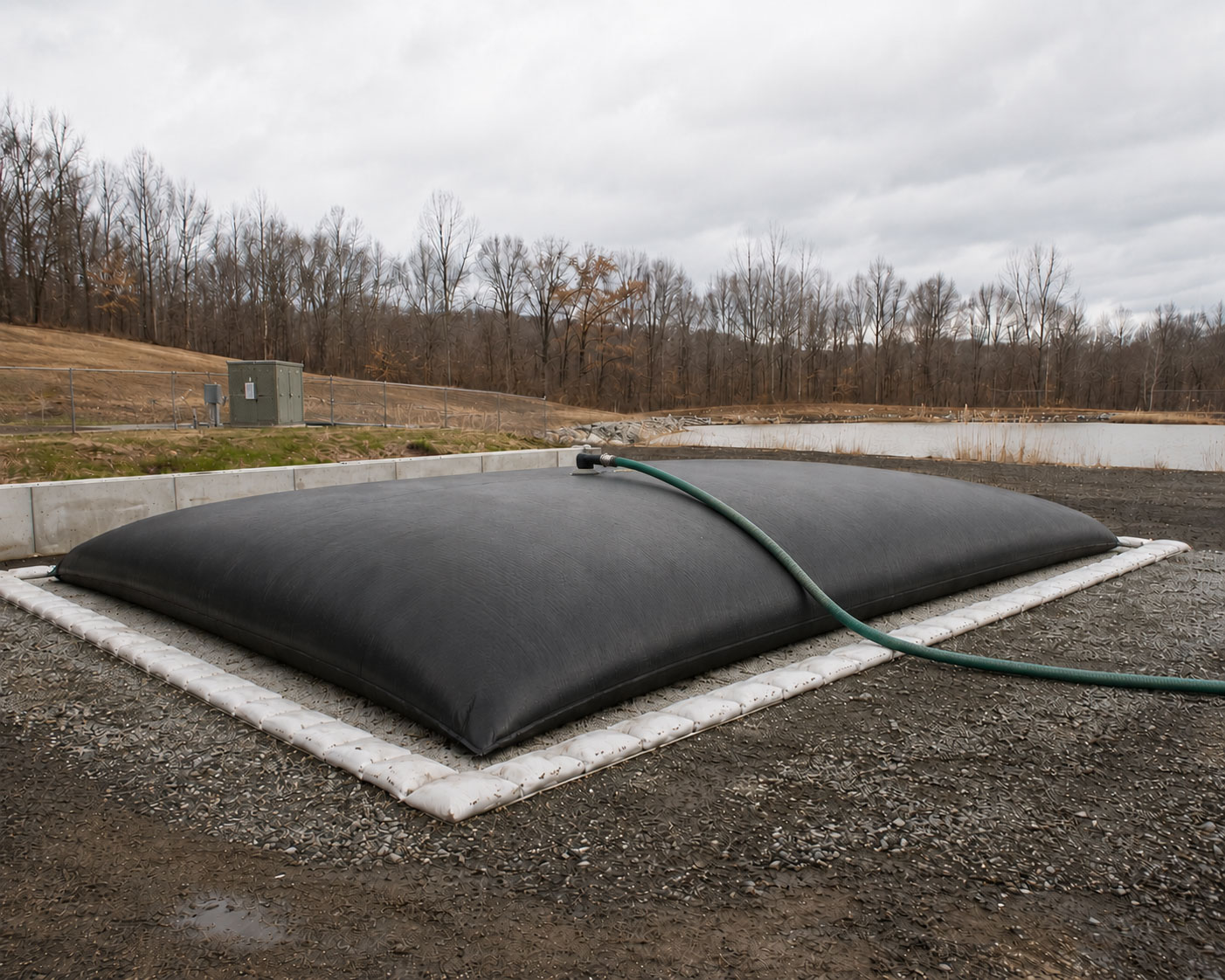
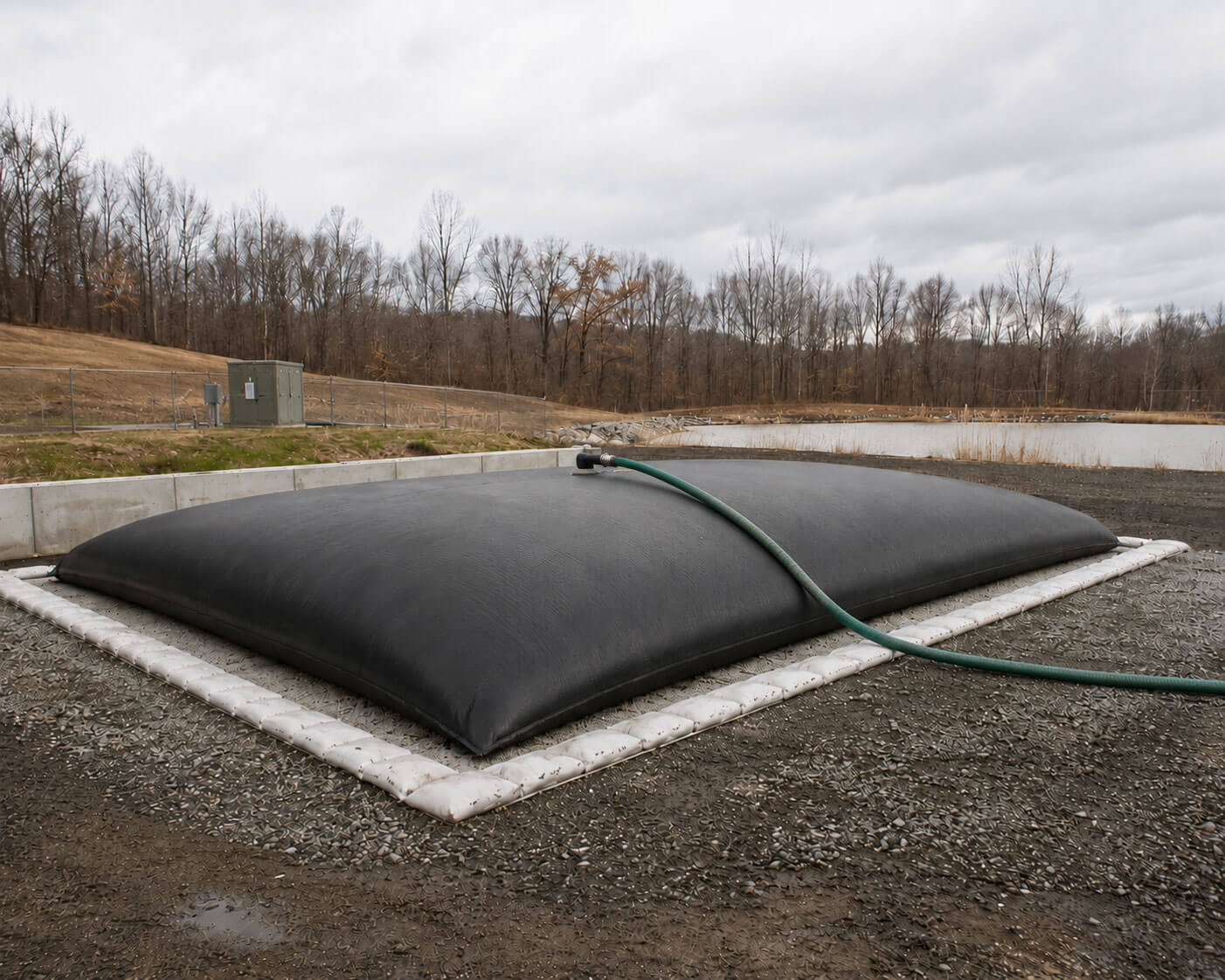
A geotextile tube is a long, closed container sewn from high-strength woven filter fabric. It is unrolled flat on a prepared pad and filled through ports along the top. As it fills, water drains out through the fabric while the solids stay inside and consolidate.
You may also see them called dewatering tubes, geotextile dewatering tubes or sludge tubes. They all describe the same thing: a way to turn pumped sludge into a solid you can dig and haul, without a building full of equipment.
Most dewatering tube projects are one of three jobs.
Sludge builds up on the floor of a wastewater or process lagoon until it takes away treatment capacity. With geotextile tubes, that sludge is pumped out and dewatered next to the lagoon on a lined pad. The filtrate is collected on the liner and sent to an approved outlet or sump.
Sediment dredged from ponds, canals and basins comes out as a thin slurry that is mostly water. Pumping it into dewatering tubes removes that water on site, so trucks carry solids instead of slurry.
Treatment plants use sludge dewatering tubes for digester and basin cleanouts, and in place of a permanent or temporary belt filter press or centrifuge. The dewatered cake is transported to a landfill or managed through on-site burial, depending on project requirements.
1 Pump sludge from pond or lagoon is conveyed through the system. During transfer, polymer is injected into the sludge stream to initiate conditioning. The mixture is then routed through s-curves to ensure proper blending, promoting flocculation and forming larger, more stable particles.
2 Once the conditioned slurry enters the Dewatering Tube, the engineered geotextile fabric retains the solid particles while allowing the filtrate water to pass freely through the textile for efficient dewatering.
3 After dewatering and consolidation is complete, the remaining solids form a dry cake that can be transported to a landfill or managed through on-site burial, depending on project requirements.

What goes under a dewatering tube matters as much as the tube. Filtrate leaves through the fabric along the whole length of the tube, so the tubes sit in a lined dewatering cell that catches that water and sends it to one collection point.
A typical dewatering cell has:
IEC fabricates impermeable liners for this kind of containment, so the tubes and the liner under
them can come from one supplier.
IEC Sludge Dewatering Tubes come in nine standard sizes. Size is given as circumference by
length.
| Tube size (circumference x length) | Max fill height: silts and organics | Max fill height: sand and minerals | Filled footprint, approx. (width x length) | Est. dewatered volume: silts and organics | Est. dewatered volume: sand and minerals | Max pumping rate |
|---|---|---|---|---|---|---|
| 15 ft x 15 ft | 3 ft | 3 ft | 6 ft x 6 ft | 8 cu yd | 8 cu yd | 50 gpm |
| 15 ft x 25 ft | 3.5 ft | 3 ft | 6 ft x 23 ft | 12.5 cu yd | 12.5 cu yd | 50 gpm |
| 22.5 ft x 22 ft | 5.5 ft | 4.5 ft | 7.5 ft x 20 ft | 20 to 30 cu yd | 20 to 25 cu yd | 100 gpm |
| 30 ft x 50 ft | 6.5 ft | 5 ft | 12 to 13 ft x 48 ft | 99 cu yd | 85 cu yd | 150 gpm |
| 45 ft x 57 ft | 7 ft | 5.5 ft | 19 to 20 ft x 54 ft | 204 cu yd | 172 cu yd | 200 gpm |
| 45 ft x 100 ft | 7 ft | 5.5 ft | 19 to 20 ft x 97 ft | 367 cu yd | 309 cu yd | 900 gpm |
| 60 ft x 100 ft | 7.5 ft | 6 ft | 26 to 27 ft x 96 ft | 553 cu yd | 464 cu yd | 900 gpm |
| 75 ft x 100 ft | 8 ft | 6.5 ft | 34 to 35 ft x 96 ft | 794 cu yd | 661 cu yd | 1,200 gpm |
| 120 ft x 100 ft | 9 ft | 7 ft | 56 to 57 ft x 96 ft | 1,460 cu yd | 1,185 cu yd | 2,000 gpm |
Estimated dewatered volumes are for planning only. The actual volume depends on the type of sediment, how long the tube is left to dewater, and how well the polymer conditioning works, so it varies from site to site.
The right size and number of tubes depend on:
Contact IEC with those details to talk through sizing.
IEC Sludge Dewatering Tubes are sewn from a woven dewatering geotextile made of high-tenacity polypropylene yarns. The weave holds the yarns in position under load, which keeps the openings consistent while the tube fills. The fabric does not biodegrade and resists most naturally occurring chemicals, alkalis and acids.
| Property | Test method | Value |
|---|---|---|
| Wide width tensile strength | ASTM D4595 | 425 x 625 lb/in |
| Grab tensile strength | ASTM D4632 | 600 x 700 lb |
| CBR puncture strength | ASTM D6241 | 2,500 lb |
| Water flow rate | ASTM D4491 | 20 gpm/sq ft |
| Apparent opening size | ASTM D4751 | 40 US sieve (0.425 mm) |
| UV resistance | ASTM D4355 | 70% strength retained at 500 hours |
Seams are a double row of lockstitches in multi-ply polyester thread. Every tube carries its own identification number, so it can be traced back through fabrication to the resin it was made from.
The tubes are manufactured in the USA.
Tubes are filled through ports along the top centerline. Longer tubes have more than one,
typically spaced every 50 to 100 feet.
A PVC port clamps the tube fabric between two rigid flanges with rubber gaskets and steel bolts, which makes a stronger connection than a sewn-in port. Each port has a fabric sleeve that secures the pump or dredge discharge hose and limits leakage. Ports that are not in use stay closed during filling.
